

Owners of the 11th-generation Honda Civic are reporting a surprising range of mechanical issues — from CVT hesitations to soft brake pedals. This guide collects the most common 11th-gen Civic mechanical problems we found across forum threads and pairs each symptom with practical diagnostics and owner-tested fixes. Use the quick table below to jump straight to the issue that matches your Civic’s symptoms, including engine, CVT, suspension, and brake problems.

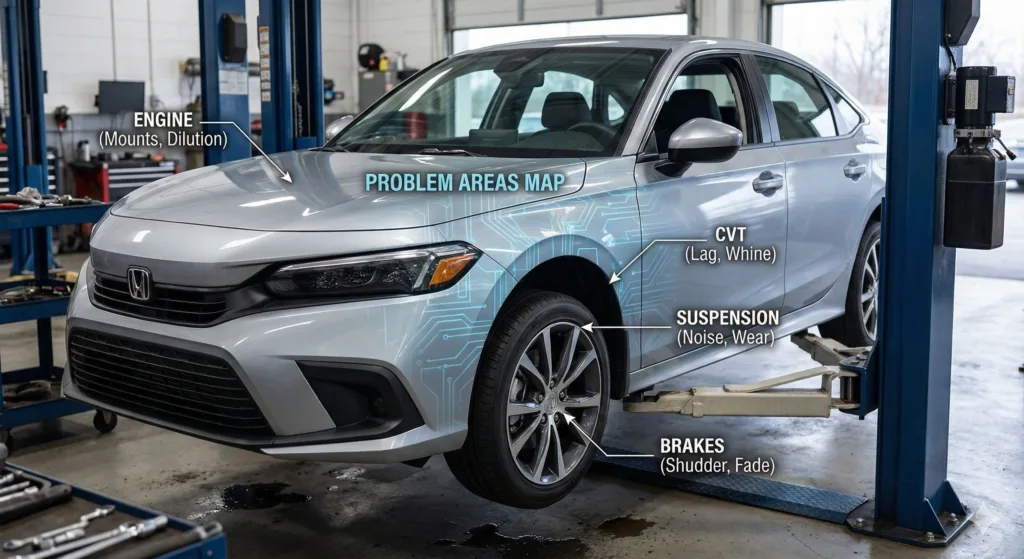
Most common mechanical problems in the 11th-gen Civic
| Problem | Typical symptom (owner phrasing) | Severity |
|---|---|---|
| Engine vibration at idle | My Civic shakes like it’s cold even after warming up. | Moderate |
| Cold-start rattling noise | There’s a rattle from the engine when I start it in the morning. | Low to moderate |
| Misfire feeling without CEL | Feels like the engine stutters but no check engine light comes on. | Moderate |
| Oil dilution in engine | My oil smells like gas and levels are rising. | High |
| Engine tick or knock | Hearing a ticking sound from the valvetrain area. | Moderate to high |
| CVT whining noise | The transmission makes a high-pitched whine during acceleration. | Moderate |
| CVT hesitation from stop | My Civic pauses before moving when I hit the gas from a light. | Moderate |
| Jerky low-speed shifts | Shifts feel rough in traffic, like a rubber-band snap. | Moderate |
| CVT shudder on highway | There’s a vibration or shake at steady speeds. | Moderate to high |
| Suspension clunking over bumps | Clunks from the front when hitting potholes or speed bumps. | Moderate |
| Loose steering at highway speeds | Steering feels vague or wanders above 60 mph. | High |
| Vibration at 40–50 mph | Whole car shakes around 45 mph, not just the wheel. | Moderate |
| Brake shudder when slowing | Brakes pulse or vibrate during normal stops. | Moderate |
| Soft brake pedal after warm-up | Pedal goes soft after driving for a bit. | High |
| Brake squeal at low speeds | Squealing noise when lightly braking in parking lots. | Low |
| Uneven tire wear after 10k miles | Tires wearing faster on one side. | Moderate |
| Battery drain overnight | My Civic’s battery dies if left for a few days. | Moderate |
Engine & Drivetrain Problems (overview)
The 11th-gen Honda Civic’s engines, including the 2.0L naturally aspirated and 1.5L turbo, are generally reliable for daily driving. However, owners report issues that often show up between 20,000 and 50,000 miles, especially in cold climates or with short trips. These can stem from normal wear on mounts or more serious concerns like oil dilution in the turbo models.
Patterns emerge based on mileage: low-mileage Civics might have cold-start noises from valvetrain components settling, while higher-mileage ones (over 60,000) see vibrations from worn mounts or misfires from fouled plugs. Forum users note that regular oil changes help, but some issues require dealer diagnostics.
Drivetrain complaints tie into engine behavior, like rough idling affecting acceleration. Overall, these aren’t widespread failures but can frustrate owners if ignored.
Common engine symptoms owners report
- Vibration at idle: Many describe a subtle shake felt through the steering wheel or seat when stopped. One owner paraphrased: ‘My Civic idles rough, like it’s unbalanced, after a few minutes.’ (Reddit r/CivicSi)
- Cold-start rattle: A brief rattling sound on startup, often lasting 5-10 seconds. Paraphrase: There’s a chain-like noise from the engine bay when it’s cold outside. (CivicX forum)
- Misfire feeling with no CEL: Intermittent stumbling during acceleration without a dashboard light. Example: Feels like the engine hesitates, but no codes show up. (Reddit r/civic)
- Oil dilution: Oil level rises with a fuel smell, common in 1.5T engines. Paraphrase: My oil is getting diluted with gas, causing rough running. (Reddit r/CivicSi)
- Engine tick: A ticking noise from the top end, possibly injectors or valves. Paraphrase: Hearing a constant tick that gets louder with RPMs. (Reddit r/civic)
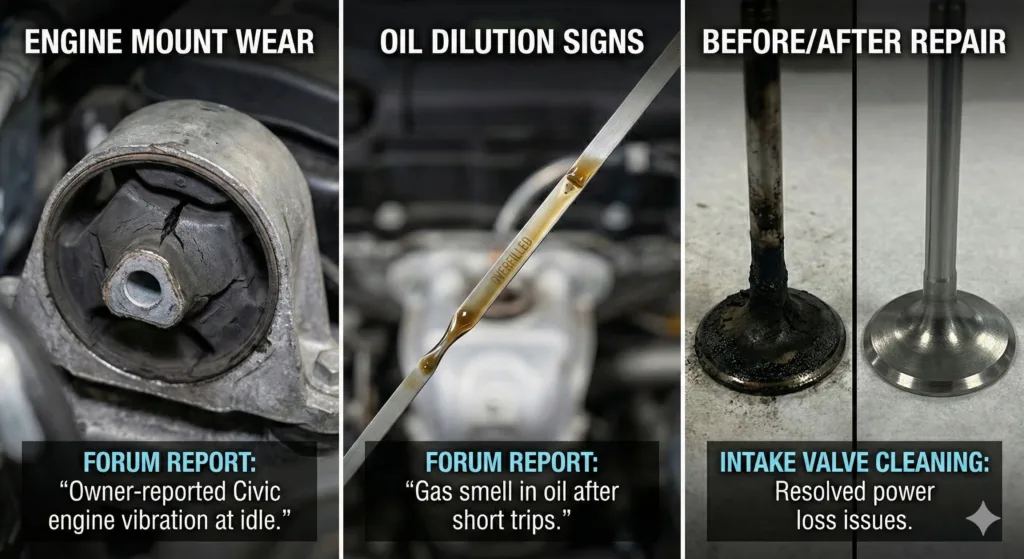
When it’s urgent — clear checklist of red flags
- Metallic knocking sound that worsens with acceleration — could indicate bearing failure.
- Blue or white smoke from exhaust — signals burning oil or a coolant leak.
- Overheating gauge or steam from hood — potential head gasket issue.
- Sudden power loss with CEL flashing — misfire risking engine damage.
- Oil pressure warning light — stop driving immediately.
Detailed Guides to 11th-Gen Honda Civic Engine Problems and Solutions
- Engine vibration at idle — causes & fixes
- Cold-start rattling noise — normal or warning?
- Misfire feeling without CEL — what to test
CVT / Transmission Problems (overview)
The CVT in the 11th-gen Civic aims for smooth efficiency, but some owners experience quirks like delayed response or unusual noises. These often appear around 30,000 miles if fluid isn’t maintained, with hesitation more common in stop-and-go traffic.
Complaints vary: some note a “rubber-band” feel during acceleration, while others hear whines under load. Honda’s CVT is generally durable with proper care, but neglect can lead to costly repairs. Forum discussions emphasize fluid changes every 30,000-50,000 miles to prevent buildup.
Typical CVT symptoms
- Whine: A high-pitched sound during shifts or cruising. Paraphrase: My transmission whines loudly when accelerating uphill. (Reddit r/civic)
- Hesitation from stop: Delay before the car moves forward. Example: Pauses for a second when leaving a stop sign. (Reddit r/civic)
- Jerky low-speed shifts: Rough transitions in parking lots. Paraphrase: Feels jerky, like it’s slipping in traffic. (CivicX forum)
- Rubber-band effect: Acceleration feels delayed or stretched. Example: Power comes on late, like stretching a band. (Reddit r/hondacivic)
- Shudder: Vibration at constant speeds. Paraphrase: Shakes on the highway like torque converter issues. (Reddit r/civic)
Quick diagnostics — 4 actionable steps
- Check CVT fluid level and color via dipstick — should be clean red, not dark or burnt; owner can do this parked on level ground.
- Test for software updates at dealer — many hesitations fixed by ECU reflashes.
- Monitor for codes with OBD scanner — no CEL doesn’t mean no stored issues; ask dealer to scan.
- Fluid change if over 30,000 miles — drain and refill with Honda CVT fluid; dealer or shop recommended.
In-Depth Resources for 11th-Gen Civic CVT Transmission Issues
- CVT whining noise — 5 likely causes & fixes
- CVT hesitation from stop — diagnostics
- Hard or jerky shifts in low-speed traffic
Suspension & Steering Problems (overview)
Suspension in the 11th-gen Civic is tuned for sporty handling, but it can feel harsh on rough roads, leading to complaints of clunks or vibrations. Issues often start after 20,000 miles, especially in areas with potholes, where mounts and links wear faster.
Steering problems like looseness appear at higher speeds, sometimes tied to the EPS system. Forums highlight “sticky steering” as a known concern, with patterns in cold weather or high mileage. Overall, these are wear items, but early checks prevent bigger costs.
Symptoms owners mention
- Clunking: Noises over bumps from front end. Paraphrase: Clunks loudly when hitting imperfections at low speed. (CivicX forum)
- Loose steering: Wanders on highways. Example: Steering feels vague above 60 mph. (Reddit r/civic)
- Vibration at 40–50 mph: Shakes through the car. Paraphrase: Vibrates around 45 mph, not tire balance. (CivicX forum)
- Popping on turns: Sounds when turning sharply. Example: Pops from suspension during maneuvers. (Reddit r/CivicSi)
- Harsh ride: Jars over potholes. Paraphrase: Suspension crashes on bumps, too stiff. (CivicX forum)
Quick checks
- Visual inspection: Look under the car for leaking struts or loose arms; use a flashlight.
- Test drive: Note noises over bumps, and record on phone for mechanic.
- Helper test: Have someone rock the steering while you listen for clunks.
- Alignment check: If tires wear unevenly, get measured at shop.
Comprehensive Fixes for 11th-Gen Civic Suspension and Steering Problems
- Clunking noise over bumps — diagnosing mounts & links
- Steering feels loose at highway speeds — what to inspect
- Vibration at 40–50 mph — tires vs drivetrain tests
Brake & Wheel Problems (overview)
Brakes on the 11th-gen Civic are reliable but can develop shudder or squeals from pad wear or rotor warping, often after 20,000 miles. Electronic features like auto-hold add complexity, leading to system warnings.
Consequences include reduced stopping power if ignored, especially with soft pedals. Forums discuss squeaks as common but fixable, with uneven wear tying to alignment. Proper maintenance extends life.
Common brake symptoms
- Soft pedal after warm-up: Pedal sinks more when hot. Paraphrase: Brakes feel spongy after driving. (Reddit r/civic)
- Brake shudder: Pulsing when braking. Example: Vibrates through pedal on slowdowns. (Reddit r/CivicSi)
- Squeal at low speeds: High-pitched noise lightly braking. Paraphrase: Squeals in parking lots without hard stops. (Reddit r/civic)
- Rear wear fast: Pads gone quicker than front. Example: Rear brakes wearing unevenly. (Reddit r/MechanicAdvice)
- System lights: “Brake system problem” dash warning. Paraphrase: Multiple lights on for brakes. (Reddit r/civic)
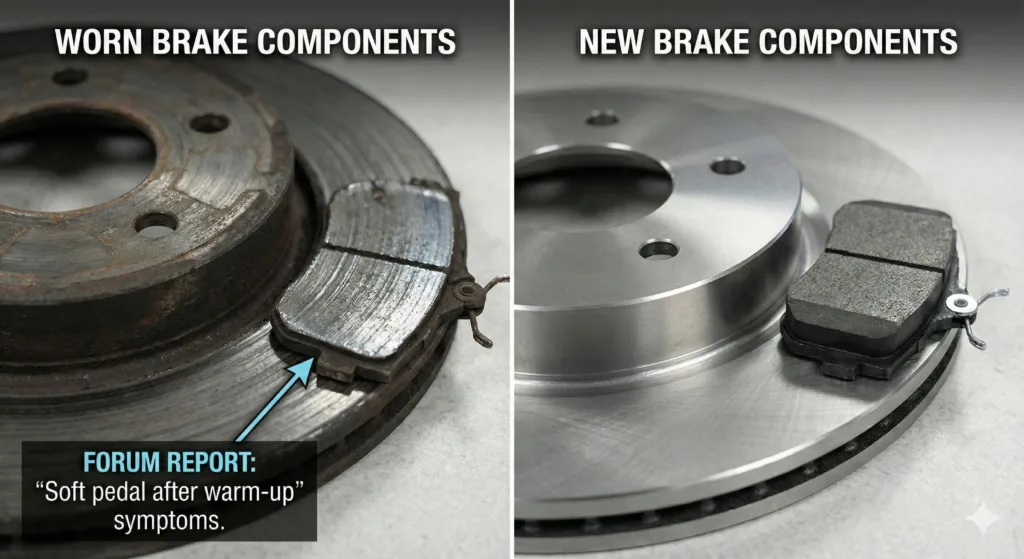
Quick diagnostics
- Reproduce shudder: Brake from 50 mph on an empty road; feel for pulse.
- Inspection checklist: Check pad thickness (min 3mm), rotor grooves.
- When to resurface/replace: If rotors are warped (over 0.002″ runout), replace; pads under 1/4 inch.
- Fluid check: Look for dark fluid; bleed if needed.
Step-by-Step Troubleshooting for 11th-Gen Civic Brake and Wheel Concerns
- Brake pedal feels soft after warm-up — diagnostic steps
- Brake shudder when slowing down — rotor vs pad analysis
- Uneven tire wear after 10k miles — alignment checklist
Early diagnosis cheat-sheet (interactive checklist)
- Start with a cold engine: Listen for rattles during the first 30 seconds.
- Idle test: Feel for vibrations at stoplights; note if AC on worsens it.
- Acceleration check: From stop, monitor for hesitation or whine.
- Bump test: Drive over known potholes; record clunks with phone.
- Braking from 40 mph: Feel for shudder or soft pedal.
- Highway run: At 50-60 mph, check steering looseness or vibrations.
- Overnight park: Check battery voltage morning after; under 12V signals drain.
- Visual underhood: Look for oil leaks and fluid levels.
Suggest to the mechanic: “My Civic vibrates at idle after warm-up, no CEL, and it happens in drive.”
Quick diagnostic checklist — Download PDF here.
When to visit a mechanic (and what to tell them)
Escalate if symptoms persist over 1,000 miles, after 30,000 miles total, or with any warning lights/noises like knocks. Don’t wait if it’s safety-related, like soft brakes.
Copy-and-paste symptom brief: “2022 Civic with 25k miles: vibration at idle, no CEL, worsens in gear. Checked plugs; seems like mounts. Also slight CVT hesitation from stop. Can you scan and inspect?”
Honda warranty, recalls & TSBs (brief)
The 11th-gen Civic has a 3-year/36,000-mile basic warranty and a 5-year/60,000-mile powertrain. Relevant recalls include sticky steering EPS gearboxes. No major TSBs found for engine or CVT, but check NHTSA for updates. Link to official: Honda Recall Search (opens in new tab). For steering, see CivicX threads on NHTSA logs.
Preventive maintenance to avoid common failures
Follow Honda’s schedule: CVT fluid every 30,000 miles, brakes inspected annually, and software updates at service.
- Change CVT fluid with genuine Honda type every 30k to prevent whine.
- Inspect brakes/pads every 10k; clean calipers to avoid squeal.
- Update ECU software at dealer to fix hesitations.
- Check battery monthly; replace every 3-4 years to stop drains.
- Align wheels after potholes to prevent uneven wear.
- Avoid hard launches; ease into acceleration for CVT longevity.

FAQ
Why is my Civic vibrating at idle?
Usually worn engine mounts or fouled spark plugs in the 1.5T. Check mounts for cracks; replace plugs every 30k. If persistent, scan for misfires. Cost: $200-400 for mounts.
Is CVT whining normal on the 11th-gen Civic?
Not entirely; often low fluid or belt wear. Change fluid every 30k; if whine continues, inspect at shop. Many owners report it fading post-service.
How can I stop battery draining overnight on my Civic?
Parasitic draw from infotainment or accessories. Disconnect battery overnight to test; common fix is software update or fuse pull. Replace battery if over 3 years old.
Why does my Civic have brake shudder?
Warped rotors from heat; resurface if minor, replace if grooved. Cost: $300-500 per axle.
Is the 1.5T engine reliable in the 11th-gen?
Yes with maintenance, but oil dilution in cold climates. Use full synthetic oil; monitor levels.
What causes suspension clunk in Civic?
Worn sway bar links or struts. Inspect visually; replace links for $100-200.
Steering feels sticky — is it a recall?
Yes, EPS gearbox issue; check NHTSA for your VIN.
Uneven tire wear — alignment or suspension?
Often alignment; get checked every 12k. If suspension, inspect bushings.
Final verdict & next steps
Prioritize safety with any brake or steering issues; start with basic checks like fluid levels. Dive into our subpages for detailed fixes on engine vibration, CVT hesitation, and more. Join the Civic Owners newsletter for free DIY guides here.